Doing It Scared

Halloween has been over for several weeks now, but to be honest with you, it feels as if it is a whole season this year rather than just a day.  It’s the one occasion of the year when we are actually given permission, indeed encouraged, to scare each other.  But it seems that this year, Halloween just keeps going on and on and on.  

You see, it is a really scary world out there. People may not be running around wearing masks and yelling “boo,” but one doesn’t need to go far to be frightened out of one’s wits.  Two large scale wars are raging and threaten to escalate into full-scale global conflict. Democracy as we know it in this nation is under serious and genuine threat. The climate is not only changing, but changing radically and quickly and in ways that will alter all life on earth.  Inflation is still on the rise causing many people on the margins to have real struggles in making ends meet.  Drug use and abuse continues to afflict young people who don’t always have the wisdom or skills to make wise choices. The list goes on and on and on. Halloween may be over, but the world in which we live continues to be terrifying.

And in the midst of these enduring frightening days, we Christians have the audacity to proclaim a God of love and a message of hope.  We followers of Christ continue to strive to live the Way of love even though our efforts seem so small, so ineffective, and even though the outcome is so unsure.  From whence comes such audacity?

Recently I heard a story from our bishop, Craig Loya, about a trip that he and his family took to the Wizarding World of Harry Potter in Florida. Having taken the time and expense to make the pilgrimage to Orlando, he and his wife discovered that their children weren’t big fans of roller coasters.  And really, the whole point of the Wizarding World is the roller coasters!  In each roller coaster line, Bishop Craig sensed the anxiety rising in his children. As they were standing in line after line waiting for roller coaster after roller coaster, Bishop Craig and his family adopted a mantra: “Sometimes you have to do it scared.”

That would be a pretty good mantra for us Christians as well. Sometimes, we will have to do it scared. You see, I don’t anticipate that the world will become any less scary than it currently is.  These present crises may be resolved, but others will take their place.  It has been the nature of human history forever, and there is nothing to indicate that pattern will change. Faced with this frightening prospect, many people will become paralyzed. Many folks, even good-hearted, well meaning folks, will circle the wagons, will hold their families tight, will look at the stranger with suspicion or contempt, will hesitate to reach out, will put a freeze on their giving to good causes.

What about us who choose the Way of Jesus?  Christians trust in God’s providence, God’s grace, God’s eternal protection and salvation.  But that doesn’t mean that we won’t be scared or that following the Way of Christ will be easy.  Even if we have generous portions of faith and hope and love, we will be scared at times.  What does a truly courageous life of love look like?  Well, it looks like days of doing the deeds of Jesus, even when we’re scared.

May we choose to love even when we’re scared.  May we choose to give even when we’re scared. May we choose to welcome the stranger even when we’re scared.  May we choose to stand up for the poor and the marginalized and dispossessed even when we’re scared.  May we choose the Way of love, the Way of Christ, each day, every day, even when we’re scared.  It may feel like a real-life, not-so-fun, never-ending Halloween out there, but we can do this thing. It’s just that some days, we’re doing it scared.

~Father Art
Triple G

Before coming to White Bear Lake, I lived in a small town in Northern Wisconsin.  There were a few restaurants, a post office, a grocery store, an awesome natural history museum, a laundromat, (surprisingly) three real estate offices, three churches, and two gas stations.  That was about it.  One of the gas stations was named the Triple G, and a regular topic of conversation was what those three G’s stood for. Most of us agreed that two of the three G’s were groceries and gasoline.  But none of us could figure out the third G.  After much, sometimes heated, discussion, we discovered that the third G stood for gab.  That’s right, gab, as in conversation.  Gas, groceries, and gab… the sacred trinity of the small town gas station.

As I reflect on a good name for a faithful Christian life, I think that one could do a whole lot worse than Triple G.  Of course, the three G’s of a Christian life are rather different than the three G’s of a small town gas station!  For a Christian, the three G’s may stand for Grace, Gratitude, and Generosity.

First, Grace.  Grace is about God’s free gift of life and love.  God creates us and everything there is and offers it all to us.  This is grace.  When we make mistakes in our lives, God offers forgiveness and the opportunity for redemption. Again, this is grace.  God offers guidance for our lives, sustenance for our lives, hope for our lives.  Grace, grace and more grace. The apostle Paul wrote that “nothing can separate us from the love of God in Christ Jesus our Lord.”  Grace, yet again. God’s grace is where it all starts and where it all ends.

Second, Gratitude.  A faithful Christian response to God’s grace is gratitude. Gratitude for all that God has done on behalf of human beings throughout the course of history.  Gratitude for all that God has done for each of us personally.  Gratitude for the life, ministry and teachings of Jesus.  Gratitude for the loving sacrifice of Christ.  Gratitude for the blessings poured into our lives each and every day.  Gratitude for the opportunity to live lives of love. Gratitude for loving community. The more one opens the eyes of one’s heart to the grace of God, the more one cannot help but to be grateful.  

Third, Generosity. If gratitude is the natural response to God’s grace, then generosity is the natural outward expression of gratitude. In other words, a naturally grateful heart inevitably leads to a beautifully generous life. Generosity takes many forms: a kind word to a stranger, time spent with someone who is lonely, financial assistance to a worthy cause, skillful labor on behalf of one in need, etc.  There are infinite acts of God’s grace and infinite expressions of human gratitude. Likewise, there are infinite ways to live a generous life.

I suppose that one could describe Christianity in many ways.  Indeed, theological tomes and treatises have been composed for this very purpose.  The next time, however, somebody asks me what it’s like to be a Christian, I’ll tell them that it’s sort of like a small town grocery store. Triple G: Grace, Gratitude, Generosity. The sacred trinity of a faithful life.

~Father Art

True

True

I have a brother who is two years older than I.  He’s an engineer and teaches physics at a small liberal arts university in Tennessee.  I have heard my mom say on any number of occasions when referring to my brother and me, “Here’s my son, Art; he’s a priest.  And here’s my son, Steve; he’s the smart one.”  Thanks, Mom.

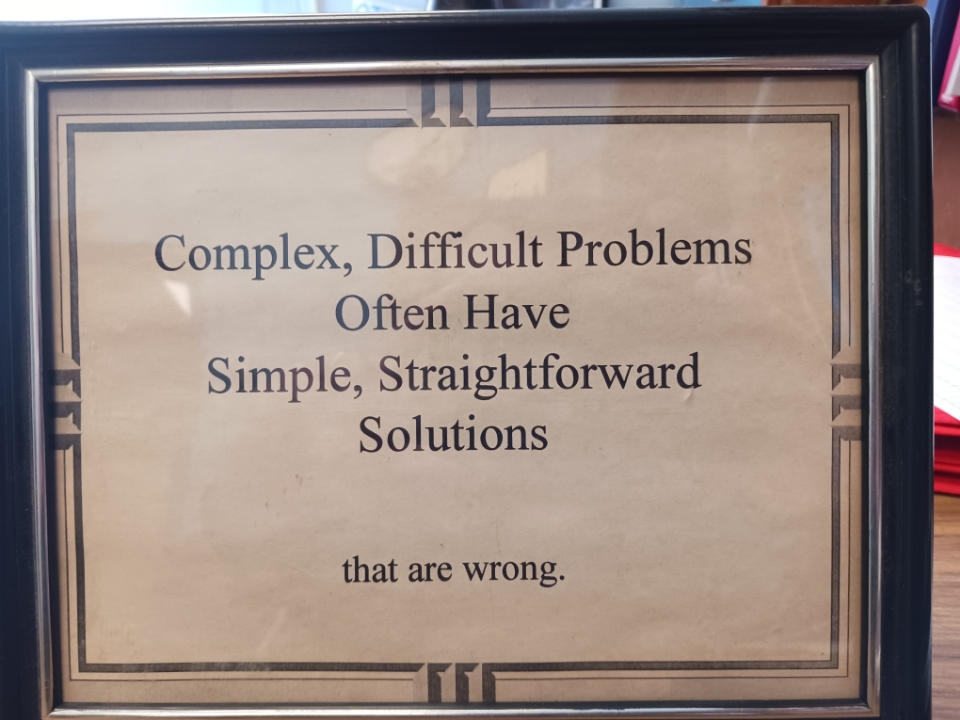
My brother has a sign hanging in his office.  It says, “Complex difficult problems often have simple straightforward solutions…that are wrong.”  Here’s a picture of the sign.

I love how the words, “that are wrong” are in much smaller print than the rest of the words.  You see, common thought is that, if we try really hard, we can find solutions to the problems of the world and the challenges of our lives, solutions that are simple and straightforward. Common thought is that such “simple, straightforward solutions” actually exist. And further, an associated common feeling to those common thoughts is that, because we cannot find “simple straightforward solutions,” there’s something wrong with us.

Could it be, however, that what’s wrong is not us?  Could it be that what’s wrong is the “simple straightforward solutions?” Could it be that what’s wrong is the very notion that such simple straightforward solutions actually exist?

There are immense challenges that we are facing in the world.  War in Ukraine.  War in the Middle East.  Political strife in our own country.  A strained economy.  Immigration concerns.  A climate crisis.  And these don’t even touch upon all the many messes in our own personal lives!  Surely, we think, there should be simple, straightforward solutions to these complex, difficult problems.  And clearly, there are always folks who are willing to step up and claim that they have the answer.  But do they?  I mean, really?  Well, the proof is in the pudding, and my observation of the pudding is that we must have left out a few ingredients.

You see, life is difficult.  It can be very, very good, but even for the most fortunate among us, life is difficult.  And the words enscribed on the sign hanging in my brother’s office have proven to be true time and time and time again.  

The world of Jesus’ day was fraught with complex, difficult problems as well.  And in Jesus’ day, just as in our own, there were folks who stepped up to claim they had simple straightforward solutions.  But they didn’t.  None of them did.

In contrast, Jesus offered few solutions.  What he did was to tell stories about what God’s kingdom looked like.  Instead of giving simple straightforward solutions, Jesus offered a vision of what the world could look like if love were allowed to flow freely.  Instead of giving simple straightforward solutions, Jesus encouraged his followers into a way of life that had the power to change the world.

Each Sunday, we retell the stories that Jesus told.  We remind ourselves of the lives Jesus encouraged us to live. We hear words of assurance that God still loves us, all of us, and that God adamantly refuses to cut and run. Each Sunday we receive not solutions to, but guidance through the complex, difficult problems of our world.  In doing so we are changed for the better, and hopefully the world, in some small way, is changed for the better too.  It isn’t simple.  It isn’t straightforward.  It isn’t easy.  But it also isn’t wrong.  It is the Way of Christ, and it is TRUE.

~Father Art

Does Anyone Want to Crash a Wedding?

This coming Sunday will be an occasion for a great celebration!  At our regular 10am service of worship, Maggie DeSmet and Nick Howe will be married.  Now, I realize that scheduling a wedding in the time slot of a regular Sunday service of worship is unusual.  I recognize that some who come to worship expecting an ordinary Sunday church experience may even feel as if they have unwittingly crashed a wedding!  But what I fail to understand is why.

You see, the Church celebrates any number of special events throughout the year.  Usually these events are directly associated with the life of Jesus.  At Christmas, we celebrate the birth of Jesus; on Easter we celebrate his resurrection from the dead; in early January, we celebrate Jesus’ baptism.  The Church, however, also celebrates events that are associated with the Holy Spirit.  Pentecost, of course, celebrates the gift of the Holy Spirit to the disciples, and less directly, on All Saints’ Day, we celebrate the work of the Holy Spirit in the lives of Jesus’ followers.

That is why I believe that there are few occasions more appropriate to celebrate on a Sunday morning than that of Holy Matrimony.  You see, the union of two people who have found love and who wish to live that love in the midst of a community of faith is the work of the Holy Spirit.  That work of the Holy Spirit should be recognized, held up and celebrated.  Just as Jesus’ life, ministry, death and resurrection witness to the love of God, so too, the commitment of two people who love each other and are committed to allowing their love to spill out into the world is a testament to the same love of God.

So, this Sunday, I sincerely hope that you will join me and many others in the St. John’s community as we gather around Maggie and Nick as they pledge their love for each other. And because their love is truly the work of the Holy Spirit, may we all, when asked whether “we will do all in our power to uphold and honor this couple in the covenant they make,” respond with voice and heart, “We will!”

~Father Art

Rotary Invocation – 20 September 2023 – Our Choice

This week in 1937, J.R.R. Tolkien published his fantasy novel, The Hobbit.  Most of us have heard of this novel; many of us have read it.  In the story, hobbits are a race of small,l humanlike creatures who value peace, simplicity, and cozy homes. One of the hobbits, Bilbo Baggins, is persuaded to join a band of dwarves in a quest to recover treasure stolen from them by the dragon Smaug.  Along the way, Bilbo finds a magical ring that, when worn, renders the wearer invisible, thus giving him an immense power advantage over others.  But along with the power granted to the wearer, the ring has its own power over the wearer, a power that proves immensely dangerous to the wearer’s very soul.

The story is, of course, the tale of Bilbo’s marturing from a simple seeker of warmth and comfort to a brave and sacrificial fighter for justice and a greater good.  The story is also, however, a story of its time, written as Hitler was on the ascent. It is a cautionary tale addressed to those nations seeking isolationist policies in the shadow of the aggressive fascism of Nazi Germany.  The story challenges us to come to terms with the deeper truths that there is no peace without justice and that peace for only some is, at best, shallow and fleeting.  The story also contends that no matter how overwhelming the situation may appear and no matter how small we may feel is our power, we can do something about it.

Jesus’ earthly ministry was one of justice and peace.  He journeyed to the hard places: places where people didn’t have enough, places where people were cruelly excluded; places of oppression and discord and violence.  In those places, Jesus brought healing.  In those places, Jesus confronted those who held power.  In those places, Jesus gave a vision of God’s Kingdom of peace, where swords were fashioned into plowshares and where lions lay down with lambs. And it is to those places and to those people that Jesus sends all those who claim to follow in the Way of Love.    

Now, we could choose, like simple hobbits, to live our lives in relative warmth and comfort, avoiding much of the unpleasantness that this world dishes out.  We could use the various rings of power and wealth that we have been given to make ourselves invisible and invincible to that which may harm us.  We could make that choice, to burrow into our little holes and to pretend not to see those who are suffering, those who go without, those who are experiencing injustice, those who are subject to conflict and war.

Or, we could make another choice with our lives.  We could choose to align our lives to the cause of beauty and truth.  We could choose to use whatever rings of power we possess in the cause of justice and peace.  We could choose to offer ourselves to the world in service to an adventurous quest for that which is so much bigger and more noble than our own little lives.

The choice is ours.  This day.  Each day.  Every day.  The choice is ours.  The quest for justice and peace is, no doubt, fraught with danger.  But make no mistake… the choice to live our lives in self-made, self-protective little holes, wearing our respective rings of power for only our own purposes… well, that is immensely dangerous as well.  Dangerous to the essence of who God has made us. Dangerous to our very souls.  

May we followers of Jesus choose well.  May we accept the invitation to join in the cause.  May we join the universal band of brave and sacrificial warriors of justice and truth and peace and love.  May we choose well today.  And may we offer freely whatever rings we may have in service to the higher cause of God’s Kingdom here on earth as it is in heaven.

~Father Art

All Shall Be Well

One week ago, a horrific earthquake shook the nation of Morocco, killing almost 3000 people.  As we were celebrating our Parish Homecoming this past Sunday, massive flooding caused two dams to rupture in Libya, killing probably over 20,000.  Human deaths caused by the fires on the Hawaiian island of Maui in August have risen to 115.  In the first 8 months of 2023, the United States has experienced 23 separate billion dollar climate and weather related disasters, the largest number ever recorded.  The toll on human life has been immense; the toll on non-human life has been incalculable.  All of this threatens to overwhelm us and cause us to become calloused and paralyzed.

While living in such difficult times, we, as God’s people, would do well to attend to the state of our hearts and minds.  Regular prayer focused on remembering God’s promises of abundant life and generous love may help us keep our hearts supple and compassionate.  Prayer often also serves to bring to mind conviction to act on behalf of those who have been affected by catastrophic events and helps us to imagine concrete ways that we may be the answer to our own prayers.  So, God’s people pray.

For most of us, however, prayer will not be enough. As God’s people who are attuned to the ways and will of God as they have been revealed to us in Scripture and through the Voice of God’s Spirit within us, we must speak truth as we understand it.  This can often be very difficult work as what we must say will make others uncomfortable or even angry.  A faithful response to catastrophic events often entails courageous truth-telling.  So, God’s people speak.

Words, however, are most powerful when they are backed up by action.  Who isn’t convinced and compelled and convicted by those who walk the talk?  The one who not only speaks truth but who actually does something about a catastrophic event is the one who is often most effective.  Raising money, picking up a hammer, bringing bottled water, praying with a victim, advocating for survivors, challenging the systems that have contributed to the catastrophe… all of these are among the many ways that God’s people are called to respond.  So, God’s people act.

All of this praying and speaking and acting can be so exhausting and unending.  It is far too easy to become dispirited by the enormity of the work.  And so, it is important to know, however, that this is God’s work and ultimately God’s responsibility.  It is critical to realize that, at the end of the day, as Julian of Norwich famously said, all shall be well.  So, when confronted with catastrophic events and our efforts to be God’s hands and heart in response, we do not lose heart.  So, God’s people remain joyful.

Most climate scientists postulate that these natural disasters will become more regular and more severe.  In response, we as God’s people,will not only persevere, we will be people of prayer, speech, action and joy.  And all shall be, and all shall be well, and all matter of thing shall be made well.

~Father Art 

Passion

The other day, I went to my local Aldi store to do my grocery shopping for the week.  As I approached the entrance, a minivan quickly pulled up beside me.  The driver, a man in his 40’s, rolled his window down and quickly got my attention by exclaiming, “Hey!  Hey!  Hey!”  I replied, “Hey?”  The man enthusiastically responded, “the watermelons are great today!”  Wow. It’s been awhile since I have experienced such passion for a vegetable!  But, let me tell you, the first thing that I did when I got into the store was to buy a watermelon.  I had to find out for myself what the source of all that passion was all about!

Passion.  What are you passionate about?  Gardening? Fishing? Golf? Hockey? Travel? Reading? Cooking? Politics? Work? Family?  In my conversations with folks, these are just a few of the things that arise as objects of passion.  And while all of these activities are commendable, I wonder whether we Christians have a commensurate passion for the good news of Christ Jesus and for the Kingdom about which he spoke.

As I read through the book of Acts, which is an account of the early life of the Church, I see followers of Jesus who are passionate.  Many of these early Christians gave everything they had for the sake of God’s Kingdom.  The writer of Acts tells us that those early believers held all of their possessions in common and they would freely give of what they had to take care of those in need.  That’s passion.  Peter, almost certainly an illiterate follower of Jesus, has the temerity to stand before learned Jewish teachers and proclaim the good news of Jesus.  That’s passion.  A man named Stephen, when brought up on false charges of blasphemy, recounts boldly the work of God in Jesus, and then gives his life as a result, being stoned mercilessly by those who fear the loss of power. That’s passion.  And then, there’s Paul… persecuted, alienated, tortured… all on account of his faith.  That’s passion.

But how do we stack up against these heroes of the faith?  How does our passion for walking the Way of Christ and living lives of Love compare to that of these early believers?  I don’t know about you, but I don’t do so well.

The good news is that God never gives up on us, and always provides us with opportunities to reignite our passion for the love of God in Christ Jesus.  I like to think that that’s a big part of what we’re trying to do at St. John’s.  Together, we are trying to be a community that is passionate about living the Way of Jesus.  Our Pray/Grow/Serve programs throughout the year are all designed to remind us of the life God has given us and to offer us ways that we may respond to God’s love with generous lives.

Now, I’ve got to tell you… the watermelon… it was indeed soooooo good!  But that watermelon is nothing compared to the life in Christ that God offers us each and every day.  Now that is something to become truly passionate about!

~Father Art

You Are Capable of Choosing

A few weeks ago as I sat on a beach by White Bear Lake, watching my dog swim and rereading a book of poetry, I came across the following piece by Mary Oliver.

Mornings at Blackwater

For years, every morning, I drank

from Blackwater Pond.

It was flavored with oak leaves and also, no doubt

the feet of ducks.

And always it assuaged me

from the dry bowl of the very far past.

What I want to say is

that the past is the past,

and the present is what your life is,

and you are capable

of choosing what that will be, 

darling citizen.

So come to the pond,

or the river of your imagination,

or the harbor of your longing,

and put your lips to the world.

And live

your life.

Each day of our lives consists of a series of choices that we make.  We decide when to wake up, what to have for breakfast, if we’re going to take a shower.  We decide who to call on the telephone, which emails to respond to, what errands to run.  We decide what plans to make, what dreams to pursue, who to visit.  Even when things happen to us that are beyond our control, we choose how we will respond. And the trick to an abundant life is to make many, if not most, of our choices consistent with “the pond or river of [our] imagination or the harbor of [our] longing.”  

Ah, there’s the rub… what exactly does our pond of imagination or our harbor of longing look like?  Jesus helps us with this by painting a picture of the Kingdom of God.  He does this mostly by telling strange stories called parables.  And the overarching theme of the parables is that God’s Kingdom occurs where love, peace, joy abide.  God’s Kingdom is that realm where justice and mercy and compassion are exhibited.  Jesus’ pond of imagination is that condition by which the poor are lifted up, the sick are made whole, the oppressed given encouragement, the enslaved free.  Jesus’s parables tell us of his pond of imagination, his harbor of longing.  It is a picture of a loving God that accepts all and loves all always.     

As we grow as Christians, we find that our pond of imagination begins to look remarkably like that of Jesus; our harbor of longing becomes the same as that of Jesus.  As Christians, we come together each week to be reminded of that pond, of that river, of that harbor of our longing.  We double down on our commitment to do what we may to bring about God’s Kingdom here on earth as it is in heaven.  

But it is only when we leave church that our real work begins.  Our real work lies in all the choices that we make each minute of each day to bring about God’s Kingdom.  If we make enough choices that are consistent with God’s Kingdom, not only our lives, but the lives of many others will move toward abundance and Jesus’ pond of imagination and harbor of longing becomes a reality.

So, when you wake up tomorrow morning, remember….

that the past is the past,

and the present is what your life is,

and you are capable

of choosing what that will be.

~Father Art

Less is More

Last week I had the distinct pleasure of embarking on a canoe trip into the Boundary Waters Canoe Area with several of our parishioners.  It was a fantastic trip as we journeyed through the woods and upon the waters of one of Minnesota’s true natural gems.  We are so blessed to have this fine example of God’s handiwork so close to us.

I’ve lost count on how many BWCA trips I have been, but probably around fifty or so.  I started to come up to Minnesota from my home in Tennessee with my dad in the early 70’s.  He had been canoeing in the Boundary Waters since he was a boy scout in the 30’s, and he was anxious to get his young family into this pristine wilderness area.  I’ve learned a lot in all of those years and on all of those trips, but much of what I have learned may be boiled down to this: less is more.

You see, BWCA canoe trips are not for the faint of heart. They are physically strenuous and require not just paddling many miles across lakes, but also portaging all of one’s gear across the usually very poor hiking paths that link lakes.  Because it is a wilderness area, all of this paddling and portaging must happen without aid of any mechanized equipment.  Not only are motors prohibited, one may not use anything that even has a wheel.  A manual cart, for example, a device that is so helpful to me in getting my paddleboard from my house to the beach on White Bear Lake, is not allowed in the BWCA.  Because of this, people who are experienced with BWCA trips learn to go light. Lighter gear and less food/equipment usually leads to a happier, more fulfilling experience.  Over the years, it has become somewhat of a game for me to discover just how little clothing, food and equipment I need to be safe and have fun in the wilderness.  I have found that, truly, less is more.

Most of us play a very different sort of game in our everyday lives. Our American economy is fundamentally based upon people purchasing things, and we have become really good at this game.  Most of us have so much more than we really need, and indeed, many of us would concede that all of this stuff weighs heavily upon us. The material things of our lives become more burden than blessing; the things of our lives that were promised to provide abundant life, instead suck the life right out of us.  So many of us have discovered the oxymoronic truth that just as less is more, more is less.

We really don’t need much.  In his sermon on the mount, Jesus says, “Look at the birds of the air; they do not sow or reap or store away in barns, and yet your heavenly Father feeds them. Are you not much more valuable than they? Can any one of you by worrying add a single hour to your life?”  In other words, don’t sweat it!  God loves us and will give us what we need to live full and abundant lives. It is true that having enough and having what one needs is a very good thing.  But it is also true that having too much can be a very bad thing.

May we be grateful for what we have.  May we be generous with what we have.  And may we learn the lesson yet once again that, so often, what is true in the wilderness is true also when we get back home… Less is More.

~Father Art

Pray, Grow, Serve

For several years we have been using three words to describe what we do at St. John’s.  These words are: Pray, Grow and Serve. Not surprisingly, these words are all verbs because the Way of Christ, the path of all Christians, entails movement.  Sometimes the movement occurs only in our hearts and minds as we strive to become more like Jesus.  But for most of us, the movement extends to our bodies as we try to do the things that we believe Jesus would do. This is actually what it means to become a disciple of Jesus: to think and see and feel as Jesus would think and see and feel; and then, to do something, just as Jesus did in his own earthly ministry.

Beginning in September, we will engage in a new program year at St. John’s. The program staff of the church met recently to discuss themes for the 23-24 year.  As a starting point, we used the key words I mentioned above: pray, grow, serve. Launching from these words, we have divided the year into a number of themes, and our programming will be focused on these themes.  The themes are as follows:

September 10: Parish Homecoming and Ministry Fair

September 11-October 28: Feed the Hunger

October 29-December 2: Rejoice and Give Thanks

December 3-24: Prepare the Way

December 25-January 5: Receive the Christ

January 6-February 13: Walk in the Light

February 14-March 23: Embrace the Dark

March 24-April 6: Celebrate New Life

April 7-May 18: Tend the Garden

May 19-September 7: Rest and Recreate

Of course, you will be hearing much about this year’s program as we will be offering many opportunities to pray and to grow and to serve.  Please note that the purpose of our parish programming is not to just stay busy.  Each day of our lives is given to us a pure gift, an opportunity to live into the abundant life that God offers each one of us.  Our program is intended to help us see the Kingdom of God and participate in God’s Kingdom work in the world.  God willing, as we do that, we will become more like Jesus, and God’s Kingdom will come more fully into our lives here on earth as it is in heaven.

So, I invite you to join us as we continue our journey together.  I encourage you to come alongside your siblings at St. John in the Wilderness as we pray and grow and serve and become more like Jesus.

~Father Art